 Free Virtual Casino
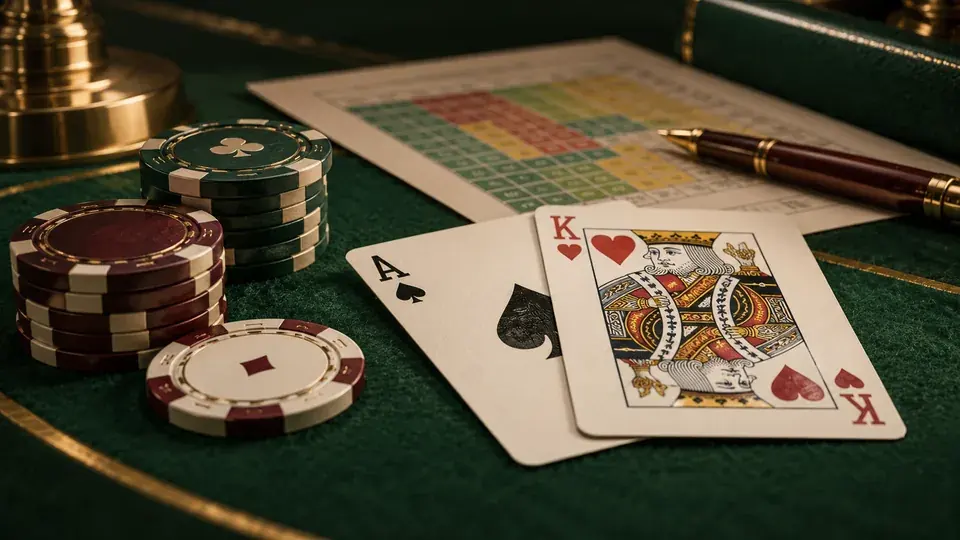
The central idea
Good blackjack is a series of small comparisons
Basic strategy asks one narrow question: with this hand, this dealer card and these table rules, which legal action has the best average result if the situation is repeated?
That is different from guessing the next card. A correct hit can bust and a poor stand can win. The quality of the choice is measured across many repetitions, not by the outcome that happens to follow it once.
The complete S17 decision map
Match your hand to the dealer’s upcard
Find your row on the left, move across to the dealer’s visible card, then follow the letter in that square.
| Your hand | 2 | 3 | 4 | 5 | 6 | 7 | 8 | 9 | 10 | A |
|---|---|---|---|---|---|---|---|---|---|---|
| Hard hands · no ace is counted as 11 | ||||||||||
| 17+ | S | S | S | S | S | S | S | S | S | S |
| 16 | S | S | S | S | S | H | H | H | H | H |
| 15 | S | S | S | S | S | H | H | H | H | H |
| 14 | S | S | S | S | S | H | H | H | H | H |
| 13 | S | S | S | S | S | H | H | H | H | H |
| 12 | H | H | S | S | S | H | H | H | H | H |
| 11 | D | D | D | D | D | D | D | D | D | D |
| 10 | D | D | D | D | D | D | D | D | H | H |
| 9 | H | D | D | D | D | H | H | H | H | H |
| 8 or less | H | H | H | H | H | H | H | H | H | H |
| Soft hands · the ace is counted as 11 | ||||||||||
| A,9 | S | S | S | S | S | S | S | S | S | S |
| A,8 | S | S | S | S | S | S | S | S | S | S |
| A,7 | S | Ds | Ds | Ds | Ds | S | S | H | H | H |
| A,6 | H | D | D | D | D | H | H | H | H | H |
| A,5 | H | H | D | D | D | H | H | H | H | H |
| A,4 | H | H | D | D | D | H | H | H | H | H |
| A,3 | H | H | H | D | D | H | H | H | H | H |
| A,2 | H | H | H | D | D | H | H | H | H | H |
| Pairs · use only when the two cards can be split | ||||||||||
| A,A | P | P | P | P | P | P | P | P | P | P |
| 10,10 | S | S | S | S | S | S | S | S | S | S |
| 9,9 | P | P | P | P | P | S | P | P | S | S |
| 8,8 | P | P | P | P | P | P | P | P | P | P |
| 7,7 | P | P | P | P | P | P | H | H | H | H |
| 6,6 | P | P | P | P | P | H | H | H | H | H |
| 5,5 | D | D | D | D | D | D | D | D | H | H |
| 4,4 | H | H | H | P | P | H | H | H | H | H |
| 3,3 | P | P | P | P | P | P | H | H | H | H |
| 2,2 | P | P | P | P | P | P | H | H | H | H |
If doubling is unavailable: D means double if allowed, otherwise hit. Ds means double if allowed, otherwise stand.
Scope: this is a conventional S17 reference map. Different payouts, deck counts, surrender rules or restrictions on doubling can move marginal decisions.
See zones, not 280 squares
The dealer card changes the job of your hand
The map becomes less intimidating when you read it as a set of pressure zones. A low dealer card does not automatically mean “stand,” and a high card does not automatically mean “hit,” but it tells you who is under more pressure to improve.
Soft hands get more freedom because the ace can fall from 11 to 1. Pair decisions answer a different question: whether two fresh starting points are more useful than the combined total you already have.
A useful piece of probability intuition
Why stiff hands feel so uncomfortable
With a hard total, every card above 21 is an immediate loss. The figures below use a fresh-deck rank mix before accounting for any visible cards, so they are memory aids rather than live shoe calculations.
Hard 16 busts on 6, 7, 8, 9 or any ten-value card — 32 of 52 cards in an untouched deck. That explains the fear of hitting, but not the whole decision. Against a dealer 10, standing is also poor; basic strategy hits because the average loss is smaller, not because the hand has become favorable.
Expected value combines the chance of every result with its payoff. The recommended square is simply the available action with the highest total — sometimes a positive opportunity, often just the least costly option.
Four squares worth understanding
The map is not a list of slogans
Read the felt before the map
Table rules can matter more than a marginal square
No basic-strategy map is universal. Before using one, check the blackjack payout and whether the dealer hits or stands on soft 17. Then check doubling, splitting and surrender.
With common multi-deck, 3:2 rules and accurate basic strategy, the house edge is often around one half of one percent. That is an order-of-magnitude guide, not a promise: deck count and every rule above shift the actual figure.
A side bet is not a safety belt
Why the map leaves out insurance
Insurance pays 2:1 when the dealer has a ten-value hole card. A 2:1 bet needs to win more than one third of the time to be profitable. Ten-value cards make up 16 of 52 cards in a fresh deck — about 30.8% before adjusting for exposed cards — so the ordinary, uncounted situation does not clear that break-even point.
That is why basic strategy normally declines insurance. Card counting can change the information available, but that is a separate system from the fixed map on this page.
A short way to learn the map
Memorise the borders, then the exceptions
- Start with hard totals. Learn the stand block against 2–6, then notice that hard 12 waits until dealer 4.
- Add the doubling spine. Hard 9 doubles against 3–6, hard 10 against 2–9, and hard 11 across the row in this S17 map.
- Anchor the pair rules. Always split aces and eights here; never split tens or fives.
- Finish with soft hands. Read the diagonal band of doubles, then remember that A,7 and A,8 have stand fallbacks when doubling is unavailable.
Use our free Blackjack Simulator to call the action before pressing a button. The game uses virtual chips only, and its optional coach can explain the recommendation. Its Five-Card Charlie rule creates a few game-specific overrides, so the live coach is the final word inside the simulator.
Keep exploring
Games and guides from VirtualFreeCasino
 Blackjack SimulatorTest decisions with virtual chips and an optional live coach.
 Roulette SimulatorExplore European roulette bets, payouts and probability.
 Poker SimulatorPlay Casino Hold’em heads-up against a virtual dealer.
 Free Slot SimulatorSpin classic reels using the same virtual balance.
All GamesBrowse every simulator and educational article on the site.
VirtualFreeCasino HomeReturn to the complete collection of free casino games.
Free Slot SimulatorSpin classic reels using the same virtual balance.
All GamesBrowse every simulator and educational article on the site.
VirtualFreeCasino HomeReturn to the complete collection of free casino games.
Quick answers
Questions about the decision map
What does basic strategy actually optimise?
It maximises the expected value of the current decision under the stated rules. When every option is negative, it selects the one with the smallest average loss.
Does following the map guarantee a winning session?
No. The map improves decisions before unknown cards are dealt. It cannot remove variance or turn a house-edge game into a guaranteed profit.
Why are aces and eights split?
Two aces make an awkward 12 with only one ace usable as 11, while two eights make hard 16. Splitting replaces those weak combined totals with two new starting hands.
Why is hard 12 different from hard 13?
Hard 12 can only bust immediately on a ten-value draw in the simple fresh-deck model. Hard 13 also busts on 9, so it reaches the stand zone sooner against weak dealer cards.
What should I do when doubling is not offered?
Hit the hard doubles, soft 13–17 and pair fives. Stand with A,7 or A,8 when their preferred double is unavailable.
Why might the simulator coach disagree?
The simulator includes Five-Card Charlie, an automatic win with five cards without busting. That extra payoff can change close decisions, so its live coach evaluates the actual game rules.